Guide to Kansas Marriage Records
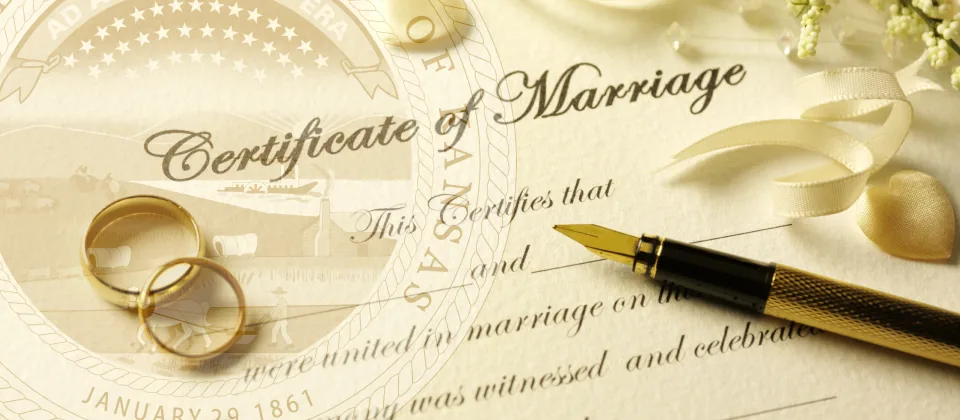
Marriage documents are official records created and maintained by government authorities that indicate that two individuals are legally married. These documents reveal details such as spouses' full names, marriage date, marriage location, and the officiant's name.
Commonly referenced marriage documents include a marriage license, marriage certificate, and marriage record.
A marriage license is the permit that you purchase to allow you to legally marry. A marriage certificate is the document that proves that you are legally married, while a marriage record consists of all the marriage-related documents held by the state, including the marriage license application, the marriage certificate, and all other supporting filings.
People search marriage records in Kansas for different purposes. Some people require the records for legal purposes, such as proving their marital status in a divorce case or in an estate matter. Others may obtain these documents for administrative purposes, such as to prove their name change to government agencies.
Types of Marriage Records in Kansas
| Record Type | Purpose | Issued By | Validity/Notes |
|---|---|---|---|
| Marriage license | Gives a couple legal authority to marry. | District court clerk | Valid for six months. |
| Marriage certificate | Provides official proof that the marriage took place. | Kansas Department of Health and Environment (KDHE), Office of Vital Statistics. | Printed on secure safety paper and is accepted by all federal and state agencies. |
| Marriage verification letter | Proves an individual is single. | KDHE Office of Vital Statistics. | Confirms that a search of state records turned up no active marriage. |
| Historical marriage records | Used mainly for genealogy and historical research. | County district courts and Kansas Historical Society collections. | Availability and format vary widely by county and era. |
Commonly searched Kansas marriage records include the following:
Marriage Certificates
This document proves that a marriage took place. It provides essential information, including the couple's names, the date of marriage, the county where the marriage took place, and the signatures of the couple, witnesses, and the officiant.
A certified copy of the marriage certificate is issued by the Office of Vital Statistics for all marriages that took place from May 1, 1913, to the present.
A certified copy is required in various legal matters and governmental verification purposes, including updating the name on a passport and adding a spouse to health insurance.
Marriage Licenses
A marriage license in Kansas is a document that must be obtained before the couple can get married. While a marriage certificate provides proof of marriage, the marriage license indicates that the couple is authorized to marry in the State of Kansas.
Marriage licenses are issued by the clerks of the district court and are valid for six months from the issuance date.
Marriage Record Verifications
Kansas issues “Verification of No Marriage Letters” as a means of verifying marriage record searches in the state. Rather than indicating whether a marriage took place, it indicates that the search did not find any evidence of marriage for that name in that state during the specified search period.
Verification of No Marriage Letters are issued by the Kansas Office of Vital Records.
Are Marriage Records Public in Kansas?
Marriage records maintained at the state level in Kansas, such as marriage certificates held by the Office of Vital Statistics, are not public records. They are only released to a person named on the record, an immediate family member, a legal representative, or a person showing a direct interest in the record.
While the marriage information maintained at the district court level has a public component, not every detail in marriage license applications is publicly available. Per Kansas court rules, full marriage licensing documents held by a district court are generally confidential. However, district courts must make a limited marriage record available to the public. The public version does not include Social Security numbers, dates or cities of birth, mothers' maiden names, or other information designated as confidential.
What Information Is Included in a Marriage Record?

The amount of information in a Kansas marriage record varies by era and record type. A record may include:
- Full names of both spouses
- Former or prior names
- New legal name chosen at marriage, when applicable
- Marriage license number
- Date the license was issued
- Date of marriage
- Place of marriage
- Ages or dates of birth
- Birthplaces
- Addresses or places of residence
- Names of parents
- Name or title of the officiant
- Names of witnesses
- Signatures or certification showing that the ceremony took place
Note that per state court rules, details like Social Security number, date or city of birth, mother's maiden name, and other designated confidential information are redacted from the public.
How to Find Marriage Records in Kansas
Step 1: Identify the Marriage Details
To start, gather all available details about the record you need. You will need the names of both spouses, the date of marriage, and the county or city where the wedding took place.
Step 2: Find the Record Custodian
For marriages that occurred after 1 May 1913, the primary custodian is the KDHE Office of Vital Statistics in Topeka, Kansas. However, if the marriage happened before May 1, 1913, the records are held by the district court clerk in the county that issued the marriage license or in the local county archives.
Step 3: Choose How to Search
The following options are available for finding Kansas marriage records:
- Online: The state's partner, VitalChek has a portal that offers access to recent marriage records.
- By Mail: Complete and submit a paper application to the state or county office.
- In Person: Walk into the vital statistics office in Topeka for same-day service.
- Third-Party Databases: Use approved genealogy platforms, such as FamilySearch, to access older records.
Step 4: Submit a Record Request
To finalize the process, you must submit the request to the appropriate custodian and include a copy of your government-issued photo ID to verify your identity. You must complete the appropriate application forms, state your relationship to the couple, and pay the applicable fee. Processing times vary from immediate turnaround for in-person requests to several weeks for standard mail requests.
How to Get a Certified Marriage Certificate in Kansas
The Kansas Office of Vital Statistics issues certified copies of marriage certificates for marriages held from May 1, 1913, to the present. However, state vital records are restricted, which means that the requester has to be the person named in the record, a qualified family member, a legal representative, or someone who can prove a direct legal or property interest. Also, the requester must be aged 18 or older.
A third party not falling under these categories would need to obtain written authorization or other acceptable documentation to prove legal entitlement to the record.
To obtain a certified copy, you must submit a completed Application for Certified Copy of Kansas Marriage Certificate, and provide acceptable identification. The ID may be a current driver's license, state identification, passport, or military identification card. The KDHE provides alternative forms of documentation for individuals who do not have a government-issued photo ID. These alternatives are listed on the application form.
The fee for a copy of a Kansas marriage certificate is $20. The first $20 is a legally defined fee for a five-year search for records. Ordering options for requesters include the following:
- Walk-in: Service costs $20 per copy and takes around 15-20 minutes when the record is readily available.
- Regular or priority mail: Service charges $20 per copy and usually takes about 7-10 business days.
- VitalChek online: This third-party service charges $20 in addition to $15 for expedited service. Processing time is about 3-5 business days from receipt of payment.
- Telephone: Costs $20 plus a $15 expedited service fee and takes about 3-5 business days from receipt of payment.
- iKan app: Costs $20 plus a $5 processing fee. For will-call orders, it takes one business day, while for mailed orders, it typically takes 7-10 business days.
A certified copy can serve as official proof of the marriage for purposes such as name changes, identification, benefits, estate administration, property matters, or other legal and administrative needs.
How to Get a Marriage License in Kansas
The Kansas marriage license application process can be submitted electronically through the Kansas court system. A couple can submit their application through a Kansas district court in any county of Kansas and then use the license, once issued, to get married anywhere in the state.
Identification details are required of both individuals, along with their email addresses, during the electronic application. Furthermore, Kansas law allows the clerk or the judge to require an affidavit concerning the parties' legal age.
Kansas does not require applicants to be residents of the state before they are eligible for a marriage license. However, the state imposes age limits for marriage license applicants.
The usual minimum age for a marriage license applicant is 18 years, but the state also allows exceptions for younger applicants in limited situations. Under certain circumstances, a judge can authorize a marriage for a 15-year-old, provided the judge finds that it is in “the best interests” of the applicant. Applicants aged 16-17 must obtain written consent from their parents or guardians. Under certain situations, judicial consent may also be needed, depending on which parental consents are available.
The current fee for a marriage license is $85.50, and an electronic payment processing fee is charged separately. Official court sources list an additional fee of $2.14 for credit or debit card payments and $1.25 for electronic checks in district courts that utilize an electronic payment process.
The state has a mandatory waiting period of at least three days after the application is filed before the license becomes valid. However, this waiting period can be waived by a judge under emergency or other extraordinary situations. After this, the marriage license remains valid for six months from the date of issuance.
According to Kansas law, couples must make declarations before an authorized officiant and at least two witnesses who are over 18 years old. The authorized officiant can be a member of the clergy, a judge, or another individual qualified by a state court. However, couples may require that their marriage ceremony be performed in accordance with the traditions or laws of their religion, without an officiant. Additionally, the officiant must file the marriage license with the district court within 10 days.
Who Can Request Marriage Records?
Access to a certified state marriage certificate in Kansas is open to a limited category of individuals. Such persons must be aged 18 or older and be:
- Either person named on the marriage record.
- Immediate family members.
- A legal representative.
- A legal guardian with supporting documentation
- A person who can prove a direct interest involving personal or property rights
- An authorized third party with the necessary written authorization and identification
According to KDHE rules, direct interest, legal representation, or written authorization must be established when a requester is neither the person named on the record nor an immediate family member.
Note that members of the public may be able to access limited marriage record information from a district court.
Free and Online Marriage Record Searches

Although certified marriage records require payment, you can still obtain marriage information online for free. For instance, the Kansas Historical Society offers free online indexes for older marriages, while many county district courts have publicly accessible terminals or online platforms where you can look up case indexes for free. Some genealogy networks, such as FamilySearch, allow you to access historical marriage entries free of charge.
A free search provides only index information, such as names, dates, and counties of filings. No legally acceptable documents can be obtained from these searches; hence, you will need to pay for the search and file a formal application if you need official verification or certified marriage documents.
If you are conducting a blind search for a marriage record and do not know the date or location of the event, consider searching using the bride's maiden name rather than the spouse's new last name. If the state index fails, you may look up local church bulletins, newspaper obituaries, and military records. These sources often mention where a couple originally registered their union.
Common Law Marriage in Kansas
Kansas remains one of the few states that officially recognizes common-law marriages. To establish such a union in the state, a couple must meet certain eligibility requirements.
First, both parties must be of legal age (18) and mentally competent to marry. They must mutually agree that they are married at that time and hold themselves out to the community as spouses.
Kansas also recognizes common-law marriages established in other states, provided they meet those states' requirements.
Since common-law marriages skip the traditional court licensing process in Kansas, no public vital statistics records are generated for those marriages. Hence, if a couple entering into a common-law marriage wants to have their status officially recorded for matters such as insurance or employee benefits, they must sign and file a notarized affidavit of marriage with the local county court.
How to Correct an Error on a Marriage Record
Errors may be found on a Kansas marriage record in varying forms. For example, either or both spouses' names may have been misspelled, a birthdate may be incorrect, a parent's name may have been entered incorrectly, or the marriage date or location may be incorrect. Such errors may be corrected through amendment applications filed by either spouse named in the record or their legal representatives.
If the marriage date or location on the record is incorrect, the spouses named on the record must submit a notarized request to the KDHE. The department requires supporting information from the marriage officiant or a courthouse duplicate indicating the correct information. If the officiant is deceased, an affidavit may be required from one of the witnesses to the ceremony.
Mail the completed notarized application form, payment, and any certified supporting documentation to:
Kansas OVSAttn: Amendment Unit
1000 SW Jackson, Ste. 120
Topeka, KS 66612
The KDHE charges a $40 fee, which includes a $20 record amendment fee and a $20 certified copy fee. The processing time for an amendment request typically takes between three and five weeks.
Marriage Records and Name Changes
For a married individual, a certified marriage certificate can serve as proof of a name change after marriage. This document is often requested by several government agencies for individuals seeking to process a marriage-based name change in their records.
Examples of such agencies include the following:
- The Social Security Administration (SSA) to update a Social Security card.
- The Kansas Division of Vehicles to update a driver's license.
- The U.S. Department of State to update a passport.
It is important to note that changing your name in government agency databases does not alter the marriage record itself. A marriage record will permanently show the maiden and legal names held on the wedding day. The details on the record may only change if an amendment request, including documentation proving an error, is submitted to the KDHE.
Marriage Records for Genealogy and Family History
Counties in Kansas began maintaining marriage records earlier than statewide marriage record registrations started in 1913. Hence, researchers for ancestors who married before 1913 must go through local county clerk archives.
Although periods vary widely, the Kansas Historical Society holds marriage records from counties on microfilm. Researchers can use the society's archives catalog to look for records from a specific county. Third-party historical archives, such as FamilySearch, also allow researchers to find older marriage records.
Kansas historical marriage records can be searched using a spouse's name, license number, year, volume number, or page number. If one spouse's name search yields no results, consider using the other spouse's last name or a shortened version of the name, or extending the search date range.
Researchers should expect gaps in the details available from historical marriage records. For example, some of the earliest county records are missing, not compiled consistently, or may not provide as much information as modern records. For instance, the Kansas Historical Society notes that older marriage licenses do not include the parents' names except in cases where one of the spouses was underage.
Note that the KDHE accepts genealogy requests only in certain situations. The official guidance states that requests for records created before 1940 may be made to the Office of Vital Statistics, while requests for records created after 1940 may be made only by an immediate family member.
Frequently Asked Questions
Are marriage records public in Kansas?
Certified marriage records are confidential vital records in the state of Kansas. Only the married couple, their immediate family, or people with valid property or legal rights can request certified copies of marriage records. However, basic index information is available free of charge.
How can I find a marriage record by name?
You can look up marriage records by name on genealogy websites like FamilySearch or by making a formal request to the KDHE Office of Vital Statistics using both partners’ complete names.
Can I search marriage records online for free?
Yes, you can find basic information free of charge from the Kansas Historical Society's website database or county court terminal. Be aware that these resources will provide you with only basic information, not a certified copy of the marriage record.
How much does a marriage certificate cost?
A certified copy of a marriage certificate costs $20 from the state office, which includes a five-year search period and is non-refundable in the event a record is not located.
How long does it take to get a certified marriage certificate?
If you visit to the Topeka office of vital records in person, you can receive your certificate in 15-20 minutes. If you order online or by phone, it will take 3-5 business days for your order to arrive, while standard mail orders take 7-10 days.
Can someone else request my marriage certificate?
No, only the couple, eligible family members, legal representatives, and those having a clear legal interest may obtain certified vital records in Kansas.
What is the difference between a marriage license and certificate?
A marriage license is issued before the marriage and gives permission to marry, while a marriage certificate is issued after the marriage as proof of the marriage taking place.
Table of Contents
- Types of Marriage Records in Kansas
- Are Marriage Records Public in Kansas?
- What Information Is Included in a Marriage Record?
- How to Find Marriage Records in Kansas
- How to Get a Certified Marriage Certificate in Kansas
- How to Get a Marriage License in Kansas
- Who Can Request Marriage Records?
- Free and Online Marriage Record Searches
- Common Law Marriage in Kansas
- How to Correct an Error on a Marriage Record
- Marriage Records and Name Changes
- Marriage Records for Genealogy and Family History
- Frequently Asked Questions